Skip to content

There are only two bags in the packaging industry that are very common, but still have some differences, which make them stand out. Stand Up bags and flat bags, which are also known as vinyl pouches, are most often used for cannabis products to save them from moisture.
But… there arise some questions: How are these boxes similar and different from each other?
That’s where you need an expert with 5+ years of experience in the packaging industry to reveal the whole concept behind these pouch packaging solutions. So, keep your seatbelts flexible because we are going to talk about flexible bags.
Before discussing their similarities and differences, it’s essential to understand what stand-up mylar and flat mylar bags are.
What are Stand Up Pouches?
Stand-up pouches (or doypacks) are flexible pouches designed to stand upright on shelves or flat surfaces to enhance products’ shelf appeal.
These flexible bags feature a gusseted bottom that expands when filled with product, which makes them a highly space-efficient alternative to traditional packaging. Further, their standing up capability improves the product’s appeal to customers when they see it on the shelf.
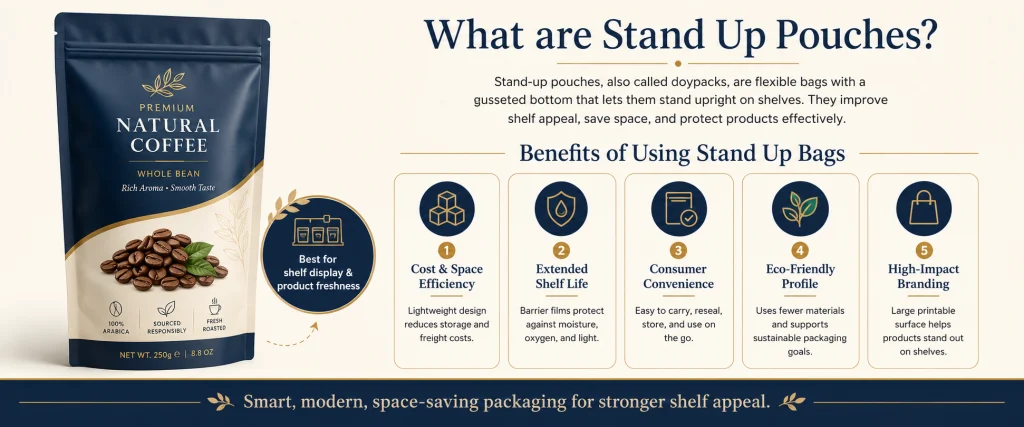
Benefits of Using Stand Up Bags
Here are some of the benefits of using stand-up bags for your products’ boosted shelf appeal to improve your sales:
- Cost and Space Efficiency: Pouches lie flat before filling, which drastically reduces warehousing and freight costs. Their lightweight, compact nature lowers carbon emissions during transit and allows for more units per truckload than rigid containers.
- Extended Shelf Life: Engineered with high-barrier films, SUPs provide superior protection against oxygen, moisture, light, and punctures, that make sure products like coffee, snacks, and supplements retain their freshness and efficacy.
- Consumer Convenience: They can be fitted with features like resealable zippers, tear notches, and handles, while making them highly portable, easy to store in pantries, and perfect for on-the-go use.
- Eco-Friendly Profile: Flexible packaging requires fewer raw materials, less water, and less energy to produce. Many manufacturers now utilize eco-conscious, recyclable, or compostable materials to help brands meet sustainability goals.
- High-Impact Branding: The front and back of a stand up pouch provide a billboard-like canvas for custom printing, vibrant graphics, and clear labeling, which helps products stand out on crowded retail shelves.
What are Flat Pouches?
Flat pouches are often known as lay-flat bags, which are 2D flexible bags that lie flat when filled with products.
These bags are not prepared for retail displays to attract customers, while enhancing their expectations from the packaging. However, these flexible packaging solutions are mostly used for storing and preserving different kinds of edibles.
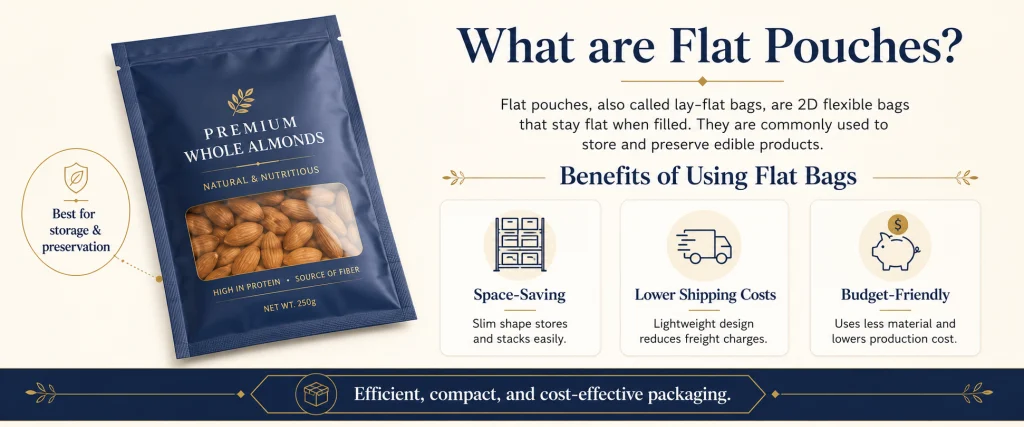
Benefits of Using Flat Bags
These are some of the advantages of using flat bags in your packaging:
- Space-Saving: Because they lack expandable sides when empty, flat bags take up minimal room in warehouses and shipping containers. They are significantly easier to stack tightly than bulky alternatives.
- Lower Shipping Costs: Their lightweight and compact design helps lower your dimensional weight and freight charges.
- Budget-Friendly: Flat bags require fewer materials to manufacture and less production time, making them a highly cost-effective choice for bulk packaging.
Similarities Between Stand Up Pouches and Flat Pouches
As mentioned before, stand-up bags and flat bags have some things in common because they are from the same family background. Thereby, we have come up with some similarities that you should know:
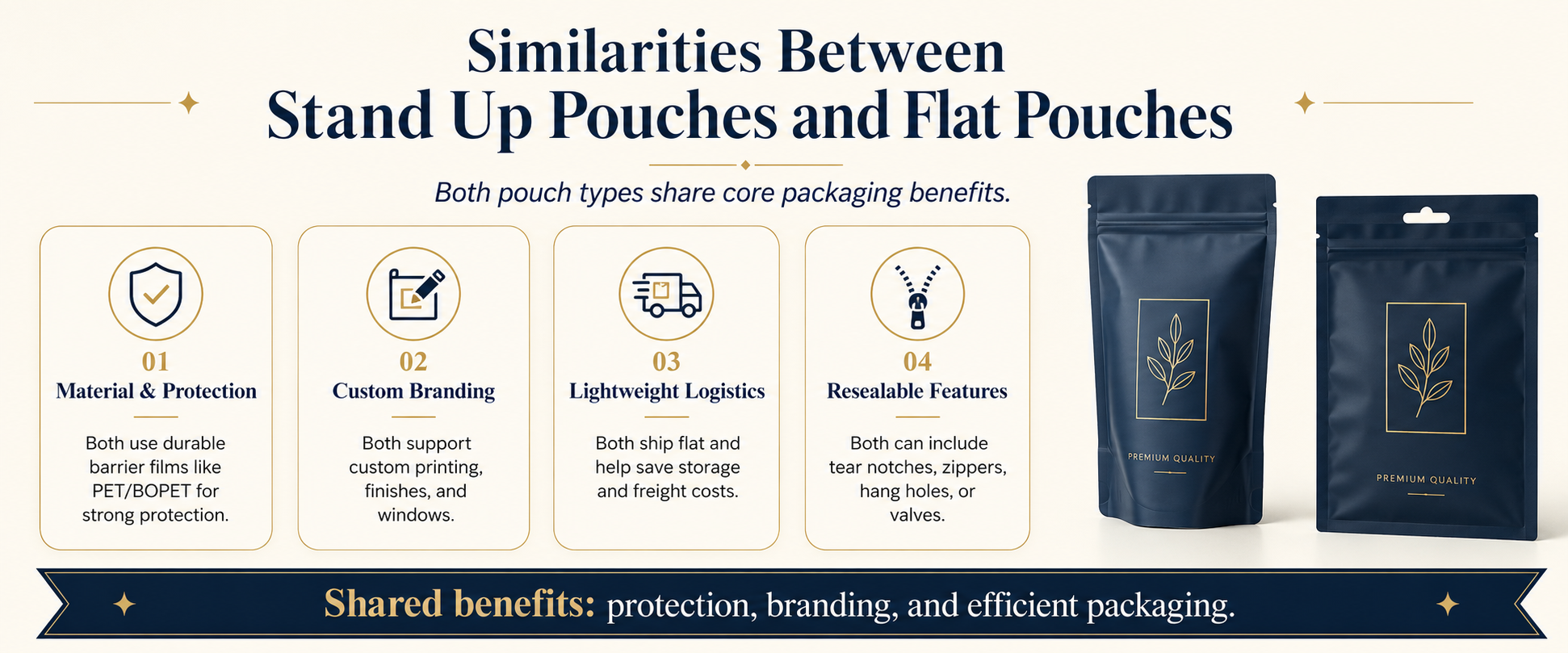
1. Material Composition & Protection
SUPs and FPs are composed of the same material, which is PET and BOPET, or in simple words, vinyl. We use these puncture-proof materials to make
2. Customizability & Branding
Both formats serve as excellent canvases for marketing. You can apply custom printing (e.g., gravure, digital), matte or gloss finishes, and transparent windows to both styles to attract customers.
3. Lightweight Logistics
Compared to rigid containers (like glass jars or heavy plastics), both pouches are lightweight and ship flat before being filled, dramatically reducing freight and storage costs.
4. Resealability and Features
Both can be customized with identical add-ons, including:
- Tear notches for easy opening
- Press-to-close or slider zippers for resealability
- Euro-slots or round hang holes for convenient peg displays
- Degassing valves (commonly used for coffee packaging)
Stand Up Pouches vs Flat Pouches: Difference Comparison Table
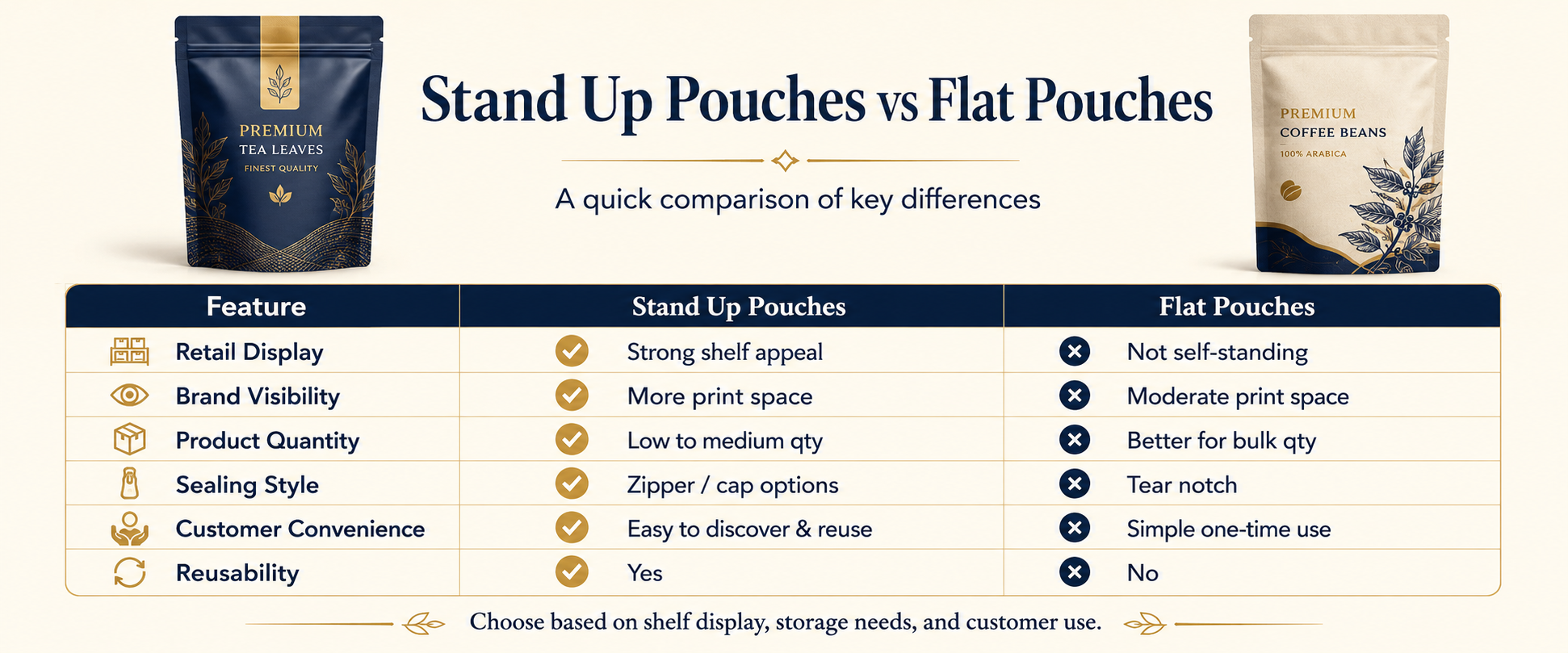
The stand-up pouches and flat pouches are different from each other in some positions, like:
| Features | Stand Up Pouches | Flat Pouches |
| Retail Display | Appealing retail shelf appeal | Can’t be displayed |
| Brand Visibility | Broader brand space | Moderate brand space |
| Product Quantity | Low product quantity | Bulk product quantity |
| Sealing Styles | Commonly, a zipper or a rolling cap | Tear notch |
| Customer Convenience | Custom handle, easy to discover | One-time need satisfier |
| Reusability | Yes | No |
1. Retail Display
Stand up style in custom mylars is used to enhance the shelf appeal of the products in retail stores and shopping malls. On the other hand, flat mylars can’t stand up on the flat surfaces, as they are prepared in 2 dimensions to ship products.
2. Brand Visibility
Flat flexible bags don’t have a broader space to fulfill your whole printing requirements, while stand up bags have a broader space for branding. Moreover, stand up flexible bags are displayed on retail shelves, and flat bags are just used to deliver products in bulk.
3. Product Quantity
As mentioned, flat pouches are used to deliver bulk products in short-term shipping and transit periods. While the stand up pouches are used to enhance the products’ overall appearance to attract a wide range of customers.
4. Sealing Styles
The stand up flexible bags are commonly used with a zipper or a rolling cap sealing style to preserve the product from moisture, heat, and oxygen. In contrast, the flat bags come in a tear notch sealing style for use and through purposes with recyclable intent if possible.
5. Customer Convenience
On stand up pouches, you can include a personalized handle for customer convenience, and they are present on shelves for easy discoverability. The flat bags are a one-time need-satisfier and are just used to deliver products in bulk quantities.
6. Reusability
At last, the stand-up pouches can be used for reusable purposes and store different items, including food-related and cannabis items. On the other side, the flat pouches are crafted for use and throwing (one-time use), and are mostly used to transport cannabis items.
The Final Talk
These are the similarities, benefits, and differences between stand up pouches and flat pouches, although they are built from the same material. If you are still reading this content, then you may be wondering where you can find the most reliable packaging company to get your dream packaging.
That’s where The Box Zilla comes in, with more than 5 years of experience in satisfying customers’ packaging needs. At this time, we are offering up to 30% discount on every order you make with no additional shipping and custom design charges.
So, why waste your precious time? Get your custom quote now and transform your packaging game in 2026!
People Also Ask
Q1. What is the main difference between Stand Up Pouches and Flat Pouches?
The defining difference is the bottom gusset. Stand-up pouches have an expandable base that enables them to stand on their own on a store shelf. Flat pouches lack this base, so they are pillow-shaped and must lie flat, stack, or be hung from display hooks.
Q2. Which one is better for retail shelf displays?
Stand-up pouches are generally superior for premium retail displays. Because they stand upright, they face forward and offer a larger billboard area for branding, logos, and product information. Flat pouches are better suited for hanging displays (using euro-holes) or in-box, space-saving storage.
Q3. Are both pouches resealable?
Yes, but stand-up pouches are far more commonly equipped with added convenience features like press-to-close zippers, spouts, or tear notches. While flat pouches can feature tear notches and simple zip seals, they are often designed as single-use or sample-sized packets.
Q4. Which packaging is more cost-effective?
Flat pouches are typically more cost-effective to produce. Because they require less material and feature a straightforward, three-sided seal, they are an excellent budget-friendly choice for mass-produced goods, bulk items, or lightweight products.
Q5. When should I choose the flat flexible bags?
Choose flat pouches if your product is:
- Small, slim, or lightweight (e.g., single-serve coffee samples, spices, beef jerky).
- Designed for a single-use application (e.g., face masks, liquid condiment packets).
- Sold on hanging peg displays.